
Supreme Court or Sarvoch Nyayalaya? Delhi High Court’s Verdict on Metro Renaming
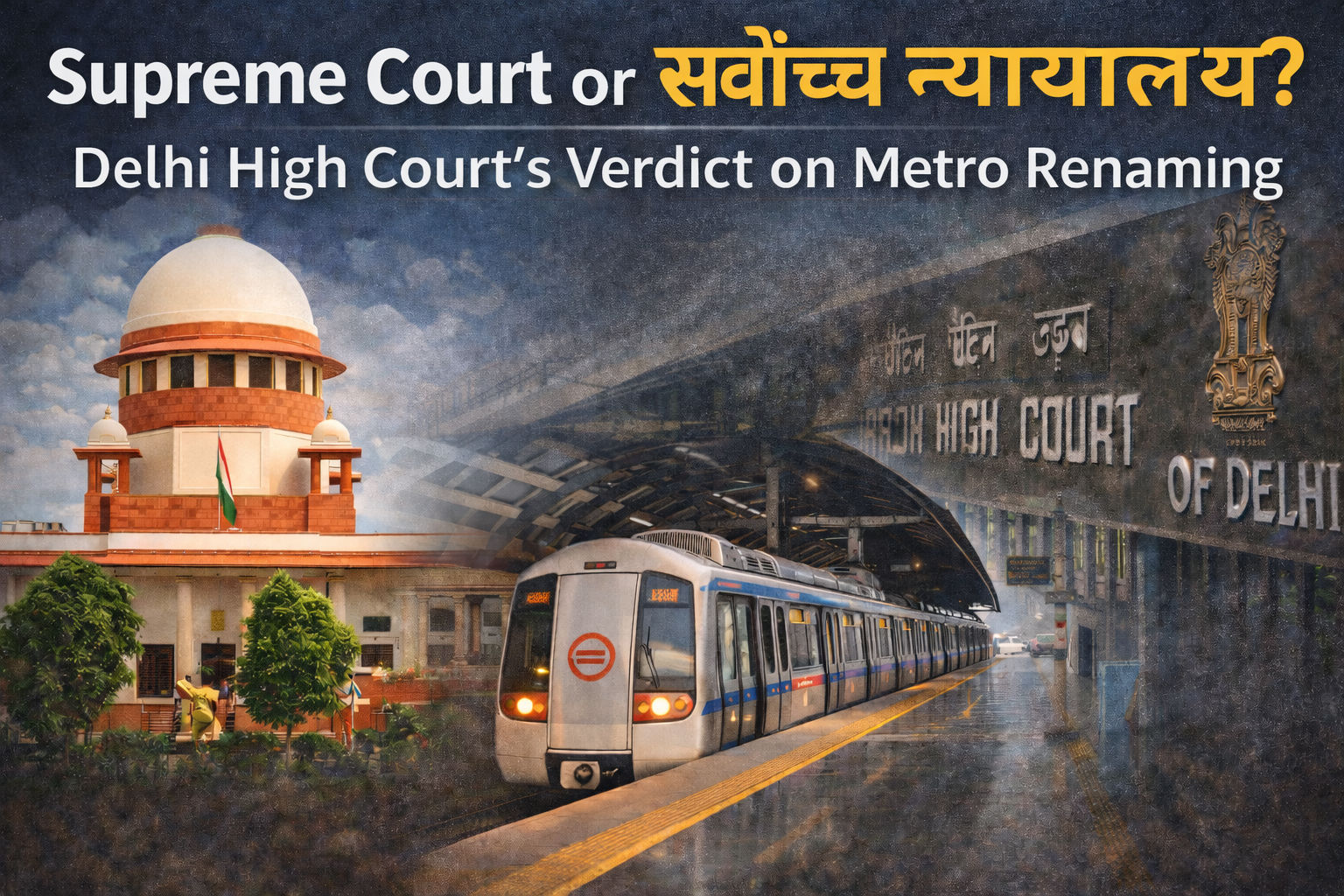
In a legal development that touches upon linguistic identity and administrative accountability, the Delhi High Court is currently deliberating a significant Public Interest Litigation (PIL). The core of the debate?
Whether the Delhi Metro Rail Corporation (DMRC) should replace the transliterated Hindi signage for "Supreme Court" (सुप्रीम कोर्ट) with its formal Hindi translation: "Sarvoch Nyayalaya" (सर्वोच्च न्यायालय).
The Genesis of the Dispute
The controversy began when a petitioner moved the High Court, arguing that the DMRC’s current practice of using transliterated Hindi (writing English words in Hindi script) violates the spirit of the Official Languages Act. The petitioner contends that since the Constitution of India and the Supreme Court’s own official documents refer to the institution as “Bharat ka Sarvoch Nyayalaya,” the public transport signage should reflect the same.
The DMRC’s Defense: The "Financial Burden" Argument
During the proceedings in February 2026, the DMRC presented several hurdles to making this change:
Significant Costs: The DMRC informed a bench led by Chief Justice D.K. Upadhyaya that renaming just the "Supreme Court" station on all signs, maps, and digital systems would cost approximately ₹40–45 lakh.
The Domino Effect: Counsel for the DMRC expressed concerns about a "ripple effect." If one station’s name is changed for linguistic accuracy, it could trigger similar demands for other stations like "High Court" or "Central Secretariat," leading to an exponential increase in administrative costs.
The High Court’s Perspective: Law Over Logistics
The Delhi High Court has shown a firm stance against the DMRC’s reluctance. The court dismissed the "lack of funds" argument, emphasizing that financial constraints cannot be a valid excuse for failing to comply with statutory language requirements.
The Court’s Observations included:
Consistency in Naming: The Bench pointed out that if Delhi University is referred to as "Vishwavidyalaya" and Central Secretariat as "Kendriya Sachivalaya" in Hindi signage, there is no logical reason why the Supreme Court should remain transliterated.
Official Language Compliance: The court underscored that government agencies must adhere to the Official Languages Act, which promotes the use of correct Hindi terminology in official capacities.
Legal Analysis: Identity vs. Utility
This case isn't just about a name change; it’s a reflection of a larger legal debate in India regarding the use of native languages in official and judicial spaces.
Article 343: While English remains the primary language for the higher judiciary, the promotion of Hindi (Devanagari script) is a constitutional directive.
Public Perception: For the common citizen, "Sarvoch Nyayalaya" carries a weight of authority and indigenous identity that "Supreme Court" (written in Hindi) may not fully capture.
Current Status and Next Steps
The High Court has directed the Central Government and the DMRC to file a detailed affidavit explaining their stance and the feasibility of the change. The next hearing is scheduled for April 24, 2026. Until then, the "Supreme Court" metro station remains a symbol of this tug-of-war between linguistic tradition and administrative convenience.
Comments 0